China Shoe and Textile Imports Drop in Mexico; Local Industry Gets Breathing Room
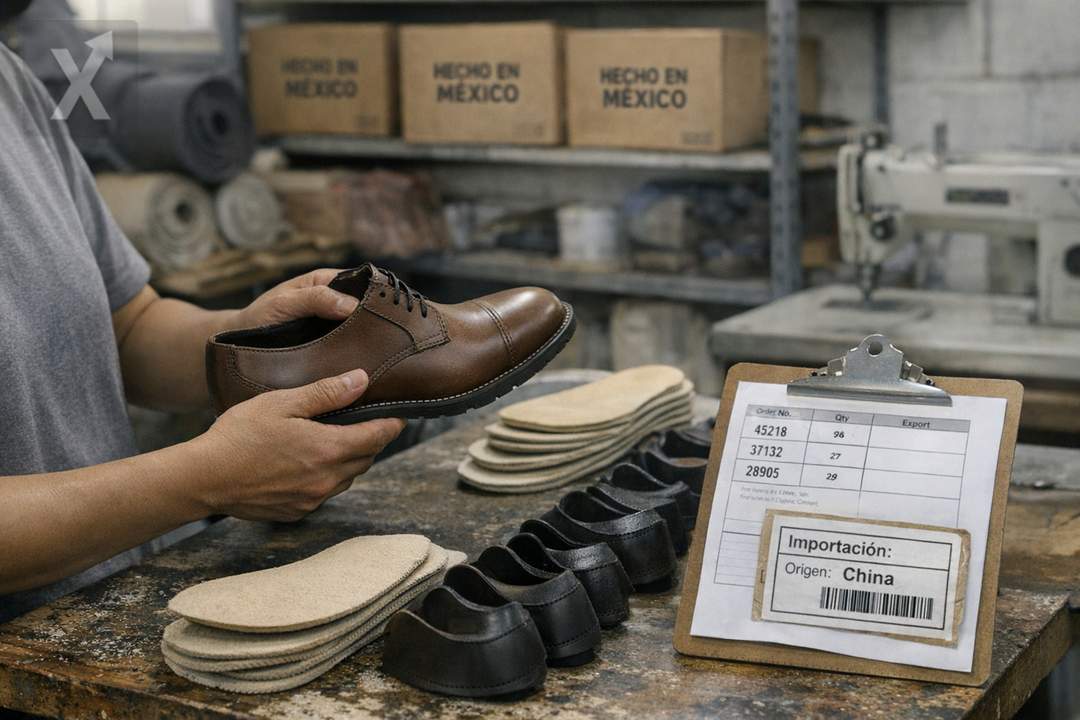
Mexico has tightened its trade policy, and it’s already showing up in fewer Chinese goods coming in—directly affecting prices, investment, and jobs.
Mexican imports of footwear and textiles from China started 2026 with a sharp pullback, signaling how the country’s industrial and trade policy is shifting toward greater restraint on low-priced products and a more explicit push for domestic sourcing. Figures for the first two months of the year show an abrupt adjustment in categories that for years have squeezed Mexican manufacturers with costs that are hard to match.
In footwear, purchases from China plunged 62% year over year, falling from $151.6 million to $57.8 million. In textiles and textile manufactures—a broad category that includes fabrics, woven inputs, and apparel—the decline was 26%, dropping from $851 million to $633 million. While overall trade with China remained high, the cut in these segments suggests a more targeted intervention in supply chains that are sensitive due to employment and the presence of informality.
The shift isn’t explained by demand alone. Since the second half of 2025, the federal government has tightened the use of temporary import programs to prevent goods meant for processing and re-export from ending up in the domestic market. That review was paired with antidumping measures for footwear and higher tariffs on products from countries without a trade agreement—steps that raised the relative cost of bringing in finished goods versus making or assembling them in Mexico.
At the same time, one data point moved in the opposite direction: imports of footwear parts—such as insoles, heel counters, or uppers—rose sharply. That mix (less finished shoes and more inputs) points to a reshuffling of production: more local assembly or manufacturing supported by imported components, consistent with partial import substitution and with supply chains trying to adapt without fully breaking their sourcing.
On the macroeconomic front, the shift coincides with a backdrop of moderate growth in Mexico, still-elevated borrowing costs, and an official strategy aimed at protecting manufacturing jobs in highly specialized regions. Footwear in Guanajuato and textiles in central Mexico are labor-intensive industries, where margin compression often quickly translates into workshop closures, more informality, or wage pressure.
Tariffs, Duties, and Financing: Redesigning Incentives to Produce
Mexico’s Ministry of Economy determined that some Chinese footwear was entering at prices deemed unfair and imposed countervailing duties per pair for transactions below a price threshold, with multi-year duration. This was followed by a tariff adjustment for countries without a trade agreement, pushing textile and footwear tariffs into the 25% to 35% range. Together, these measures change the calculus for importers, wholesalers, and retail chains: cheap imported product loses its edge, while local production gains room to win back orders—though with the challenge of modernizing and meeting delivery timelines.
The government has also promoted industrial policy tools: a financing program for machinery and production processes, aimed mainly at small and medium-sized businesses. In a country where business credit is often expensive and unevenly accessible, financing with defined terms can speed up investment in automation, quality, and compliance—key factors for competing in both the domestic market and exports.
On the business side, the adjustment is already showing up in greater purchasing from domestic suppliers and a signal of more stable demand for formal manufacturers. The challenge, however, is that the Mexican market remains highly price-sensitive: if the higher cost of imports is passed on to end consumers, the local industry must respond with productivity gains to keep demand from shifting to informal channels or lower-quality substitutes.
Another factor is the external environment. In the relationship with the United States, debate over rules of origin, customs enforcement, and trade transshipment has intensified as the review of the USMCA framework moves forward. For Mexico, reducing the inflow of Asian goods in “sensitive” sectors can serve as a political signal to Washington, but it also creates a dilemma: some of the investment that could build plants in Mexico to supply the market comes from Chinese companies, forcing Mexico to balance capital attraction with geopolitical considerations and trade compliance.
In the short term, the drop in imports from China may ease pressure on domestic producers and regional employment. Looking ahead, outcomes will depend on whether the push translates into more competitive supply chains—higher productivity, better design, stronger brands, and greater formality—or whether it merely delivers temporary relief alongside higher prices. In any scenario, the policy signal is clear: Mexico is using trade and industrial tools to reorder high-labor-density sectors and renegotiate its position in global trade.
In perspective, the cut in Chinese footwear and textile imports suggests a strategy of selective substitution backed by tariffs, duties, and credit; its success will be measured in investment, formal employment, and the ability to compete without relying on permanent barriers.






