Rising food prices challenge price controls and strain household budgets
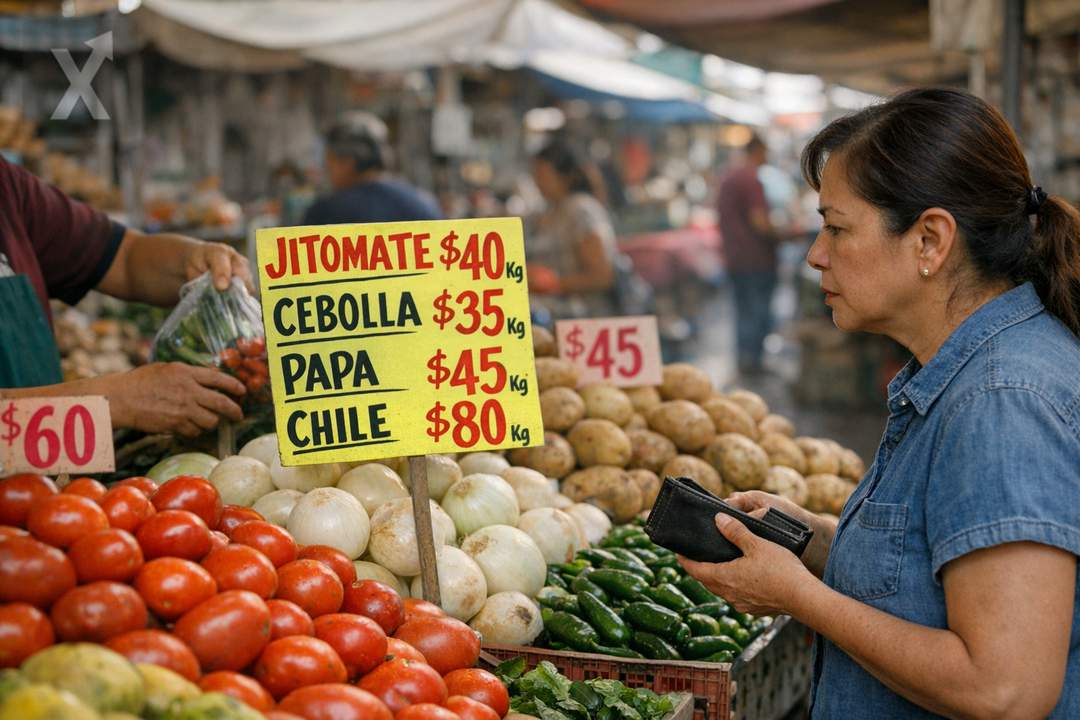
The rebound in fruits and vegetables is keeping pressure on the basic food basket and shrinking the room to maneuver for thousands of families.
Headline inflation in Mexico showed a slight slowdown in the first half of April, but the relief has been limited for consumers: higher prices for fresh foods—especially fruits and vegetables—continue to set the tone for day-to-day spending. For several high-consumption items—such as tomatoes, chiles, potatoes, and onions—increases have been steep enough to throw off weekly budgets, particularly for households that devote a large share of their income to food.
This contrast between cooling overall inflation and a pickup in non-core food inflation is reopening the debate over how effective the Package Against Inflation and High Prices (PACIC) really is, since it relies on agreements with large retail chains. The underlying issue is structural: most food purchases are made through the traditional channel—small neighborhood stores, public markets, and open-air street markets—where prices respond more quickly to supply shocks, logistics costs, and seasonal swings, and where deals with major retailers have limited reach.
In practice, agricultural products are among the most sensitive to changes in weather, water availability, pests, transportation costs, and energy prices. In addition, fertilizers and other agricultural inputs have risen intermittently in recent years due to global disruptions and geopolitical tensions—factors that show up with a lag in consumer prices as planting and harvest cycles adjust. For small merchants, with limited bargaining power and thin margins, absorbing these shocks is difficult, so pass-through to prices is often faster.
Food pressure also has a regressive effect. In Mexico, the cost of the urban food basket has been rising faster than headline inflation, increasing the risk that households on the edge slip into food labor poverty when their labor income no longer covers basic necessities. In an environment of moderate economic growth and high informality, sensitivity to sudden food price increases is greater because many families lack savings, formal credit, or strong safety nets to cushion weeks of elevated prices.
The “traditional channel,” where high prices are felt the most
Beyond the design of PACIC, the structure of retail trade limits any strategy built around agreements with large chains. The strong presence of microbusinesses—often informal or semi-informal—means less scale to negotiate with suppliers, less access to financing, and operations that run with small inventories. In that context, an increase in shipping costs, spoilage, security expenses, or even extortion along routes and at points of sale can show up almost immediately in the final price. For consumers, this translates into more frequent fluctuations, noticeable differences across neighborhoods, and a shopping experience where the “price of the day” matters more than any public price-containment policy.
Pressure on the traditional channel also has implications for measured inflation: when fresh food prices accelerate, they increase volatility in the non-core index and complicate the public’s read on whether “inflation has already come down.” Even if the national average moderates, perceptions are anchored in what goes up each week at the market, influencing expectations among households and small businesses and potentially fueling precautionary price adjustments in local services.
For monetary policy, the focus remains on core inflation, which tends to move with greater inertia and reflects more persistent pressures such as labor costs, services, and demand dynamics. However, recurring shocks in food and energy complicate convergence to the target and raise the risk of second-round effects if increases become frequent and widespread. In that scenario, the challenge for Banco de México is to calibrate the balance between sustaining the disinflation process and not worsening weak growth—particularly when consumption adjusts due to a loss of purchasing power.
Looking ahead, fruit and vegetable prices will depend on factors ranging from weather and water availability to input costs and logistics. Wage adjustments, productivity, and formal employment performance—key variables for sustaining real income—will also matter. If food increases persist, the impact won’t be merely statistical: it will show up in substitution toward lower nutritional quality products, less frequent purchases of fresh items, and additional strain on households that already devote a large share of their spending to food.
In short, the moderation in headline inflation has not translated into a clear reprieve at families’ tables: high prices for fresh foods highlight the limits of PACIC, the fragility of the traditional channel, and the persistence of risks that could delay an improvement in purchasing power.






