Mexican Strawberries in the U.S. Crosshairs: A Trade Risk for a Key Agricultural Export Engine
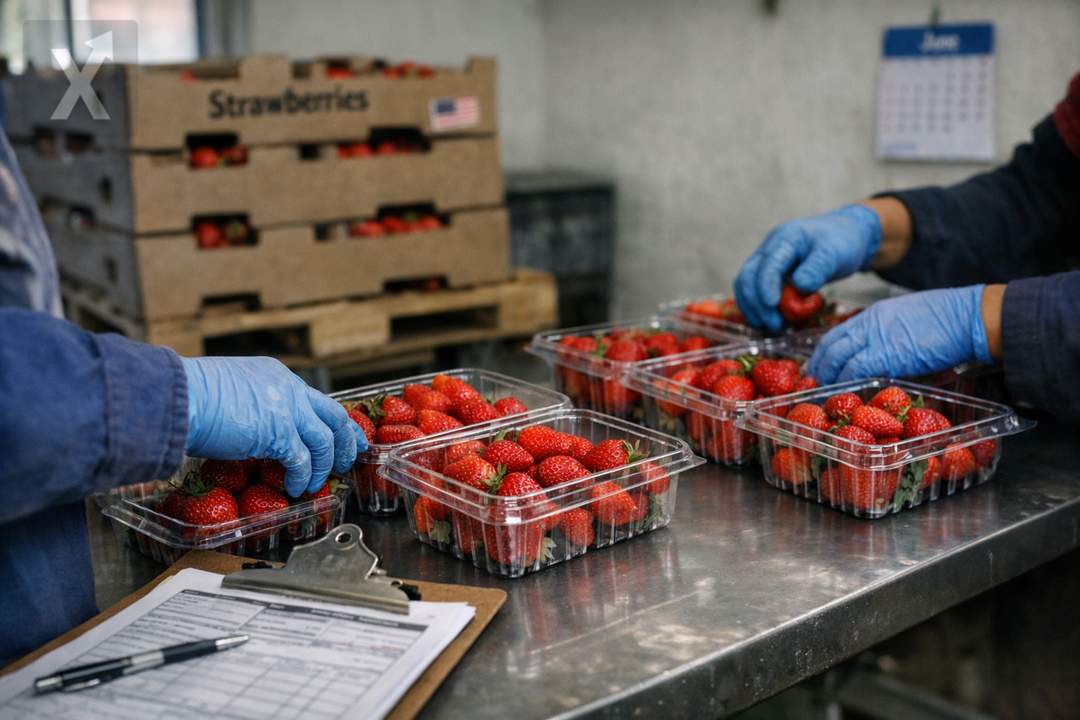
A U.S. antidumping investigation into Mexican strawberries threatens an export stream nearing $1 billion and raises agricultural tensions ahead of the USMCA review.
As Mexico’s agrifood sector is still absorbing the impact of recent trade measures on other crops, strawberries are emerging as the next pressure point in the United States (U.S.) market. The U.S. Department of Commerce has opened an antidumping investigation into winter fresh strawberries from Mexico—an action that, if it moves toward duties, could make access to the top export destination more expensive and reshape prices, volumes, and contracts across one of the most dynamic farm supply chains.
The risk is not minor: Mexico sells to the U.S. nearly nine out of every 10 fresh strawberries it exports, with production concentrated in Michoacán, Baja California, Guanajuato, and Jalisco. Altogether, this is a business worth roughly $1 billion a year, with a heavy logistics component (packing, refrigeration, transportation, and distribution) and a business structure that ranges from large exporters to mid-sized growers who depend on specific market windows.
The complaint comes from the coalition Strawberry Growers for Free Trade, which argues that Mexican exporters sell below “fair value,” putting pressure on U.S. winter prices. At the start of the process, the authority set a preliminary dumping margin of 18.32%, a figure that can still change as costs and financial information are reviewed. The preliminary determination, expected toward the end of June, has become a key marker for anticipating the tone U.S.-Mexico agricultural trade relations could take in the coming months.
The volumes at issue explain the case’s sensitivity. Between November 2024 and March 2025, the U.S. imported more than 200 million kilograms of Mexican strawberries, valued at close to $933 million, according to official figures. In a market with fast turnover, high perishability, and tightly scheduled contracts, any countervailing measure typically shows up within weeks in wholesale prices, buying decisions, and harvest planning.
From the Mexican government’s perspective, the issue has been framed within a broader concern: the growing use of antidumping and countervailing tools as de facto barriers. Mexico’s Secretary of Agriculture and Rural Development, Julio Berdegué, has said these decisions must rest on technical, verifiable evidence to avoid distortions and conflicts in a region that, for decades, has bet on integrating agrifood supply chains.
The backdrop: agrifood integration and a USMCA under greater scrutiny
The case arrives at a particularly delicate moment: agriculture is gaining prominence ahead of the USMCA review, and in Mexico there is concern about a combination of three forces reshaping regional competition. First, the tightening of U.S. trade instruments, where hundreds of active antidumping and countervailing orders have accumulated. Second, sanitary and phytosanitary frictions that disrupt flows and raise compliance costs—especially sensitive for sectors operating on thin margins with perishable products. Third, the expansion of U.S. farm support and subsidies—recent figures are around $12 billion for grains and oilseeds—which, while not directly tied to berries, fuels perceptions of competitive asymmetries and pushes Mexico to strengthen its defensive strategy in trade disputes.
Economically, an antidumping-duty scenario for strawberries could have effects on multiple layers. For growers, it would increase uncertainty about net export prices and could force changes in planting plans or investment in agricultural technology. For exporters and packers, it would mean renegotiating contracts, absorbing costs, or adjusting margins. For carriers and cold-chain operators, any reduction in flow translates into lower capacity utilization. And on the U.S. side, the impact could show up in higher consumer prices during the winter season, substitution toward other origins, and more supply volatility.
The episode also fits into Mexico’s broader macro reality: the country remains heavily dependent on exports to the U.S., and agriculture—while a smaller share of GDP than manufacturing—is crucial for regional employment, rural income, and foreign-exchange generation in several states. In an environment where investment seeks regulatory and trade certainty, sector-level disputes can amplify perceived risk, especially for activities that are logistics-intensive and heavily shaped by sanitary compliance.
Mexico’s response is unfolding on two tracks. Externally, it is to defend the case with technical information, traceability, and cost consistency to narrow the dumping margin and avoid sweeping measures. Internally, the government has proposed strengthening infrastructure, expanding productive capacity with higher value added, and raising labor standards, in line with regional commitments. In practice, these adjustments tend to be gradual, but they become strategic when destination markets increase requirements and competitors try to gain ground through trade litigation.
In the short term, the timetable of the U.S. proceeding will be decisive for the sector’s outlook. If the preliminary margin holds or rises, incentives for further legal escalation increase; if it falls or is limited to specific cases, it may create room for negotiations and operating agreements that soften the shock. Either way, the strawberry file signals that North America’s agricultural debate will be more litigation-heavy and more sensitive to domestic politics in each country.
The central message is that agrifood integration remains deep, but less automatic: strawberries are joining a list of products where market access will increasingly depend on technical defenses, compliance, and commercial strategy. For Mexico, the challenge is to protect a key export engine without losing competitiveness; and for the region, to sustain predictable rules that allow investment and supply planning with less volatility.






