Treasury expects rules within a month for zero-rate card-payment fees at gas stations
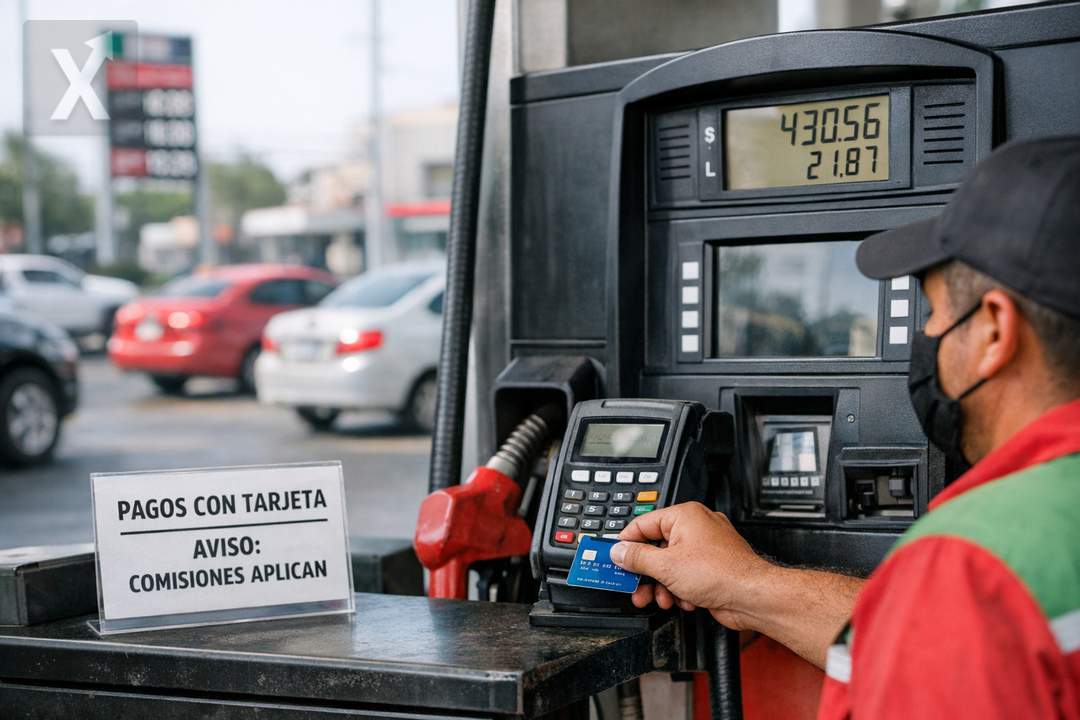
The government is looking to make card payments cheaper at service stations to help cushion pressures from the global rise in energy prices.
Mexico’s Ministry of Finance and Public Credit (SHCP) said it expects that, in about a month, the conditions will be set to apply a reduction—temporarily, down to a zero rate—in the interchange fees tied to credit and debit card payments at gas stations. The measure aims to lower acceptance costs for service stations and, in theory, ease pressure on the final price paid by consumers.
Finance Minister Édgar Amador explained that the process requires approvals within bodies of the Bank of Mexico (Banxico), the autonomous institution that plays a role in the regulatory and operational framework of the payments system. The technical definition matters because the “interchange fee” is a core component of the cost of accepting card payments: it is allocated within the payments chain among acquirers, issuers, and networks, and is typically passed on to merchants through processing fees.
The proposal, promoted by the banking industry, would be an unusual move in the Mexican market, where acceptance fees vary by business line, risk, and volume, and where the use of electronic payments has grown but still coexists with a strong preference for cash—especially among small businesses. For gas stations, the goal is to relieve an operating cost amid global volatility in oil and refined products, with spillovers into logistics, transportation, and, by extension, inflation.
From an economic policy perspective, the decision comes at a time when the fight against inflation continues to constrain room for maneuver: while core inflation has proven more persistent, non-core inflation—where energy prices carry significant weight—tends to react quickly to external shocks. Reducing friction in payment methods doesn’t replace the international price dynamics, but it can help contain costs along the commercial chain, especially for stations with a high share of card transactions.
Implications for consumers, banks, and the payments system
For consumers, the impact will depend on how much of the fee reduction shows up in pump prices or lower indirect charges; in competitive markets, a lower acceptance cost can translate into discounts, promotions, or at least less pressure to pass through commissions. For gas station operators, the measure could provide immediate cash-flow relief by making electronic payments cheaper in a high-volume business with tight margins. For banks and other payments-system participants, the challenge will be to reset incentives without disrupting operations, fraud prevention, or card rewards and related programs, which are often partly funded by that revenue. From a regulatory standpoint, the design will be key to avoid distortions: a temporary zero rate focused on one specific sector requires clear eligibility rules, defined time windows, and oversight mechanisms so the benefit reaches the intended link in the chain.
At the same event, the Treasury reiterated a growth forecast of around 3% by year-end, supported—according to the agency—by an investment package tied to the Infrastructure Plan, digitalization efforts, and a strategy to boost lending. In Mexico, where private-sector credit as a share of GDP remains below that of comparable economies, any expansion of financing is often viewed as a lever for economic activity, though its effect depends on the cost of money, business confidence, and the quality of loan origination.
Regarding fuel subsidies, the minister said support linked to diesel will continue to cushion the impact of external prices on households. The fiscal argument is that, while the subsidy implies lower collection of the corresponding tax, the consolidated effect can be closer to neutral when higher crude prices lift oil revenues. Still, analysts often warn that these schemes also face limits: they depend on the balance between oil revenues, spending needs, and fiscal discipline, in an environment where the government’s debt-service costs and social priorities compete for resources.
Looking ahead, the market’s focus will be on implementation: whether the rules are published within the expected timeframe and whether the mechanism strikes a balance between supporting the gas station sector, maintaining continuity in payments services, and delivering tangible benefits for consumers. It will also be important to see whether the measure remains a temporary tool to respond to external shocks or whether it opens the door to broader, sector-based adjustments to fees in a payments ecosystem that is becoming more digital but remains marked by high informality and significant regional differences.
Overall, the Treasury’s announcement highlights how small regulatory changes in the payments system can act as shock absorbers during bouts of energy-price volatility, although the ultimate effectiveness will depend on execution and competition along the fuel distribution chain.






