The United States Opens the Door to Cutting Tariffs on Mexican Steel and Aluminum—But Ties It to Investment on U.S. Soil
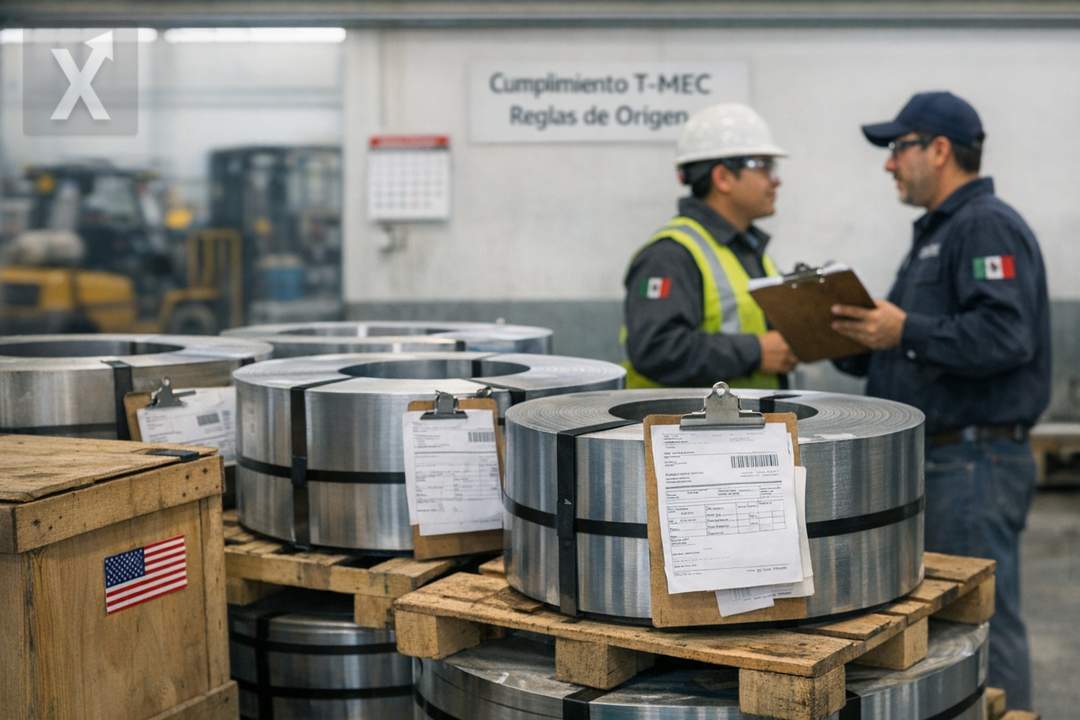
Washington formalized a framework to lower tariffs on Mexican inputs if companies expand production capacity in the United States and comply with USMCA rules of origin.
The United States published rules allowing steel and aluminum producers with operations in Mexico and Canada to qualify for a tariff reduction: certain inputs destined for the U.S. auto and heavy-vehicle industries would move from a 50% duty to 25%. The benefit, however, is not automatic; it is contingent on verifiable commitments to invest in and expand production capacity within the United States.
The procedure, released by the Department of Commerce under Proclamation 10984 and Section 232—an instrument Washington uses on “national security” grounds to adjust tariffs in strategic sectors—lays out how to apply for the preferential treatment and the technical requirements to keep it. Mexico’s Ministry of Economy, led by Marcelo Ebrard, noted that issuing these guidelines was a pending step for companies to access the benefits that had been announced.
Under the framework, the 25% rate applies only to volumes equivalent to the new production capacity committed in the United States. In other words, the tariff incentive is designed as leverage to attract investment and shift part of production to the U.S. market, rather than as a broad liberalization of metals trade.
To be eligible, companies must operate facilities in Mexico or Canada and supply—directly or indirectly—U.S. manufacturers of automobiles, trucks, buses, and auto parts. They must also comply with USMCA rules of origin and demonstrate regional traceability: for steel, they must show it was produced from the earliest stages (melting and forming) in Mexico or Canada; for aluminum, they must prove the process likewise begins in the region, from smelting through basic transformation.
Applicants must submit a detailed project specifying location, projected capacity, costs, timeline, suppliers, and evidence of milestones (land purchases, start of construction, equipment acquisition, and production start-up). Compliance will be reviewed periodically, and companies will be required to file quarterly reports with progress updates, imported volumes, and technical documentation. If a company fails to meet its commitments, it may lose the benefit and owe the full tariff retroactively on imports made under the program.
Implications for Mexico: Pressure on the Auto Supply Chain and Signals Ahead of the USMCA Review
For Mexico, the announcement comes at a time when export-oriented manufacturing—especially autos—remains a pillar of growth and foreign-exchange earnings, even as the country seeks to capitalize on nearshoring. In practice, high tariffs on steel and aluminum raise the cost of key inputs and can affect margins and sourcing decisions, so any reduction—even a limited one—can ease costs in specific segments. Still, by tying the benefit to investment in the United States, the measure also creates an incentive to shift part of industrial expansion north of the border, potentially competing with projects Mexico is trying to attract to industrial corridors in the Bajío region, the north, and the center of the country.
The “from the start” traceability requirement reinforces a recurring regional theme: tighter origin verification meant to limit the use of inputs sourced outside North America, particularly in supply chains where Asia has gained share. In Mexico, this could translate into greater demand for certification, audits, and customs controls, as well as pressure to develop regional suppliers of primary metal and strengthen processing capabilities. For companies integrated into the auto supply chain, the ability to prove origin and document processes may become as important as the price of the metal itself.
On the trade front, the framework is also being read as a political signal ahead of USMCA discussions: on one hand, it offers a path to partial relief; on the other, it preserves the use of unilateral tools (Section 232) that have historically created friction with trading partners. For Mexico, the challenge will be balancing the defense of preferential regional access with an industrial strategy that does not depend on concessions conditioned on investment outside the country.
In the short term, Mexico’s metals industry and industrial users—auto parts makers and assembly operations—will need to assess whether it makes sense to join expansion projects in the United States to capture the tariff benefit, or whether it is more efficient to redesign sourcing strategies and contracts. In the medium term, the outcome will depend on how quickly applications are approved, companies’ ability to meet investment milestones, and the stance regional governments take on the continued use of tariffs in sensitive sectors.
In sum, the tariff reduction represents potential relief—but with strings attached: it rewards investment in the United States and raises the bar for origin compliance and reporting. For Mexico, the net effect will hinge on the competitiveness of its auto supply chain, trade certainty, and its ability to retain productive investment at home.






