Global volatility hits Mexico’s Afores: March posts record paper losses and reignites the retirement-savings debate
A bout of geopolitical tension and market swings triggered the worst month on record for Afores, even as regulators push a long-term view.
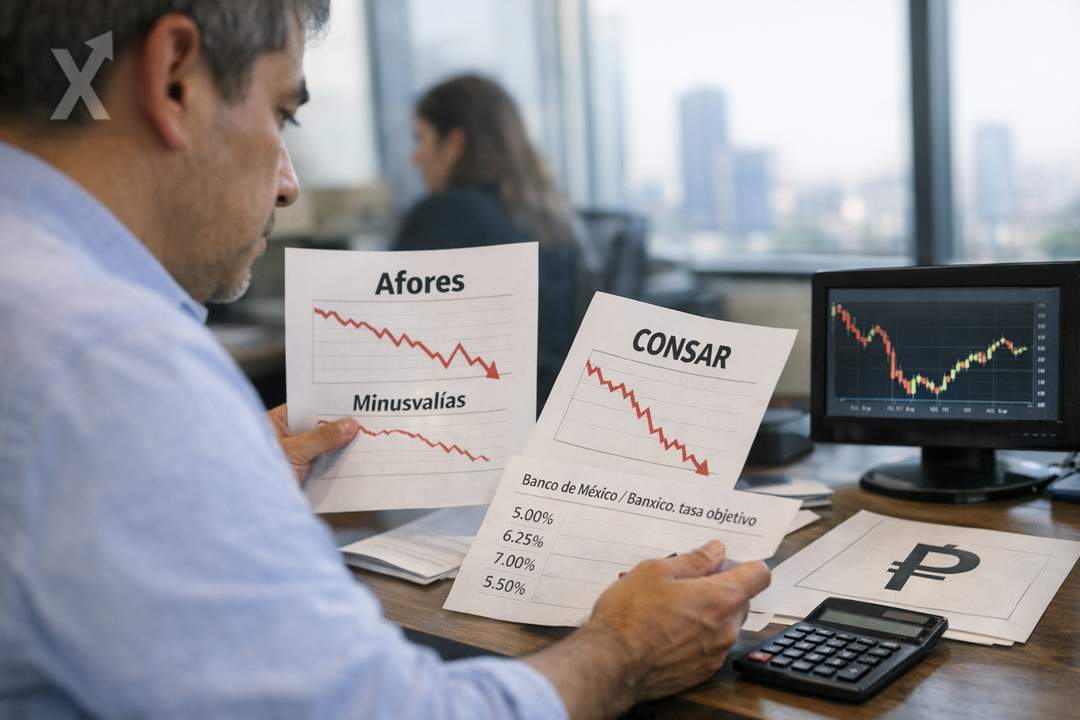
Mexico’s retirement fund administrators (Afores) faced an unprecedented episode of book losses in March: paper losses totaled 417.321 billion pesos, according to figures from the National Commission of the Retirement Savings System (Consar). The result wiped out the year-to-date gains and left the first quarter with a negative balance of roughly 111 billion pesos, in an environment dominated by risk aversion and reshuffling across global portfolios.
The immediate catalyst was a souring of sentiment in international markets following the conflict in the Middle East, which pushed up energy prices and other inputs. In that context, Consar pointed to broad declines in stock markets and valuation adjustments, with impacts especially visible in international equities and in instruments sensitive to moves in exchange rates and interest rates. For pension funds, these shocks translate into mark-to-market losses (not necessarily realized losses), which often reverse partially or fully as asset prices recover.
The regulator stressed that, with data through April 14, an improvement in gains was already visible, with profits of around 266 billion pesos. Consistent with its messaging during prior bouts of turbulence, it said these moves tend to be temporary and advised workers to avoid switching between Afores during periods of high volatility, since moving at the bottom can “lock in” temporary losses.
The episode comes at an important moment for Mexico’s retirement savings system: the 10 Afores currently operating manage roughly 8.3 trillion pesos—an amount equal to more than a quarter of GDP. That scale makes Afores a key player in local financial markets: they add depth to the debt market, create demand for long-term instruments, and, at the same time, remain exposed to global cycles due to portfolio diversification.
According to the system’s historical data, a majority of the assets under management comes from returns accumulated over decades, which helps explain why monthly results can swing sharply without necessarily altering the long-term path. In Mexico, the Siefores (the underlying retirement funds) have also gradually adjusted their asset mix as regulation has allowed greater diversification, which tends to reduce idiosyncratic risks—though it does not eliminate exposure to global shocks.
What a paper loss means for workers—and why timing matters
In practical terms, a paper loss in the Afores reflects a drop in the market value of the instruments the Siefores invest in; it is an accounting change in balances valued at market prices. The impact on a worker depends on their time horizon: those far from retirement typically hold portfolios with greater exposure to equities and therefore more short-term volatility, while those nearing retirement tend to be in more conservative portfolios. That’s why timing matters: if a worker decides to switch providers or withdraw funds during a downturn, they can crystallize the decline; if they keep their savings invested, the probability of a rebound is usually higher, though not guaranteed. Consar and the industry often emphasize this point because individual decisions, multiplied across millions of accounts, can amplify selling pressure during periods of stress.
In the background, the rate environment also looms large. After Banco de México’s tightening cycle to curb inflation, the market has moved into a phase where the debate centers on the pace and magnitude of rate cuts, depending on the inflation path and global financial conditions. Moves in the yield curve directly affect the valuation of bonds held in portfolios: when rates rise, bond prices tend to fall; when rates fall, valuations generally improve. That dynamic can intensify volatility when combined with external shocks and FX adjustments.
The performance of Afores is also closely watched because of its connection to financing the broader economy. In recent weeks, debate has resurfaced over using these resources to fund infrastructure projects. The industry’s public stance has been that any investment must meet standards for returns, structure, and risk management, while the federal government has argued that financing mechanisms are being proposed under a responsible, development-oriented approach. In that context, short-term volatility underscores the importance of designing sound investment vehicles—with clear cash flows and transparency—so as not to shift undue risk onto workers’ retirement savings.
Looking ahead, the main focus for portfolios will remain the combination of external factors—geopolitical tensions, energy prices, and international financial conditions—and domestic factors such as inflation, growth, and the path of monetary policy. If conditions stabilize, it is likely that part of the paper losses will reverse as valuations normalize; if uncertainty persists, Afores could see additional months of meaningful swings, particularly in components with higher market sensitivity.
Overall, March made it clear that Mexico’s retirement savings are not insulated from global ups and downs: the record paper losses reflect a market shock more than a structural change in the system, but they also highlight the need to keep a long-term perspective and to reinforce investment discipline and worker communication during volatile periods.